Montgomery Advertiser review
January 13, 2009
REVIEW: 'Bear Country'
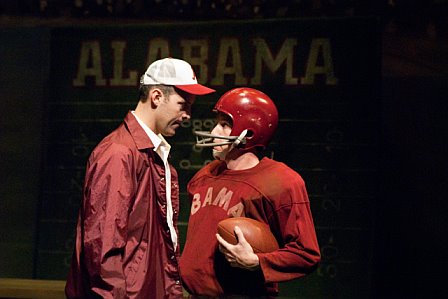 On Sunday, a day of two NFL divisional playoffs, it was fitting that the Alabama Shakespeare Festival mounted the world premiere of Bear Country, a tribute to University of Alabama Coach Paul W. Bear Bryant, whose influence has been felt for generations.
Michael Vigilant's script has been under development through the Southern Writers Project. The task of telling Bryant's story with dramatic honesty while satisfying the mythic proportions of the man established by the legions of loyal fans, coaches and former football players is daunting.
You'd better get it right is a familiar refrain in Vigilant's ears, and a particular challenge to actor Rodney Clark's personification of the iconic figure of the Bear. While it might comfort some to have an encyclopedic knowledge of the Bears stats (and there are many of them included in the text of the play), this is not merely a play about facts and details. And though it might not satisfy every individuals romanticized memory of the legend, there are enough of both in it to attest to Bryant's stature.
The Octagon Stage has been transformed to replicate a football stadium by scenic designer, Katherine Ross, going so far as to show the famous wishbone play on a game chart. Audiences sitting in the stands are thereby invited to participate in the spectacle, the struggles and the triumphs of a legendary hero during the two-hour production.
Two actors play Coach Bryant. Rodney Clark is the older version, and Gregory Jones his younger self, who appears through reminiscences of the past. Numerous characters, some 14 in all, are shared by John Patrick Hayden and Yaegel T. Welch. These four create an excellent ensemble that is credible in every instance.
The play opens on Bryant's last day at work in Tuscaloosa. As he packs up a lifetime of memories -- photographs, newspaper clippings, scrapbooks, trophies -- he reflects on his past (both personal and career events) and narrates some selected pivotal experiences that come to life on the stage. Many of them are familiar, most are pleasant and a few are either unpleasant or life-changing.
Vigilant's script is accurate in reporting the specifics, sometimes verging on a history lesson for the uninitiated instead of a dramatically interesting scene. But he is most adept at integrating these diverse elements in time to rescue the play from becoming a lecture or sermon.
Director Tim Rhoze garners bits of gentle humor out of some serious situations like segregation and accusations of game fixing, and some of the older Bears monologues demonstrate a fine sense of narrative. Rhoze seamlessly integrates the past and the present with overlapping action and dialogue, and has a firm control over the action, characterizations and storytelling.
The script and performances never veer into maudlin hero-worship. Instead, audiences are engaged by the man rather than the myth through believable characterizations. Bryant had his flaws, to be sure, though these are never the point. Clark drinks throughout the play, for example, which may account for the characters self-examination, but this is not presented as a criticism, merely a fact. And his fury at being accused of cheating is completely justified.
Act Is exposition of the facts and the essences of Bryant's good name provides a comfortable introduction to a man of principle who is indebted to family and other mentors for molding him. The principles of toughness, persistence, sportsmanship on the field, and good behavior off the field are the result of these influences. It is clear that he wants to instill these qualities into my boys, as he calls his football players.
Act II continues the last moment of the first act the accusation of fixing a game thus affording the writer and the ensemble the means with which to connect to the plays larger themes. As testimony to this, the opening afternoons audience remained silent for much of this act, with rapt attention to Bryant's (Clark's) self-analysis and philosophizing. Kudos to Clark for some of the best theatrical moments witnessed on the ASF stage in a long time.
As the play draws to a close and we remember that Bryant died shortly after he left his job in Tuscaloosa a dignified man has emerged: a man who cherishes family, a man who understands human loss, a tough man who knows that it doesn't cost nothin' to be nice, a man who has made a difference in the lives of so many.
Vigilant and company got it right.
Michael P. Howley (mhowley@alasu.edu) is a member of the American Theatre Critics Association. He teaches English and humanities at Alabama State University, and serves on the board of directors of the Alabama Conference of Theatre and the Southeastern Theatre Conference.
Gregory Jones